
Have you ever made something that smelled so good while cooking that you couldn’t stop opening the pot just to breathe it in? That’s lamb and eggplant curry. The combination of warming spices, tender lamb, silky eggplant, and coconut milk simmering together creates a fragrance that fills the entire house and makes everyone ask when dinner will be ready. The first time I made this, my neighbor knocked on the door to ask what I was cooking. Now I make it whenever I want something that feels special without requiring any advanced technique — just good ingredients and the patience to let everything simmer into something extraordinary.
Here’s the Thing About This Recipe
What makes this lamb and eggplant curry work where other home curry attempts can taste thin or under-seasoned is the blooming of the curry powder and turmeric directly in the pot with the browned lamb and aromatics before any liquid goes in. That brief toasting step — just a minute or two — activates the fat-soluble compounds in the spices and creates a depth that adding them later simply cannot match. Around here, we’ve figured out that eggplant is the secret ingredient that makes this curry genuinely special — it breaks down during the long simmer and becomes creamy and silky, thickening the sauce naturally while adding a subtle sweetness that balances the robust lamb. The coconut milk provides richness without heaviness, and the long, gentle braise transforms tough lamb shoulder into fork-tender pieces. It’s honestly that simple.
What You’ll Need (And My Shopping Tips)
Lamb stew meat from the shoulder is the right cut for this lamb and eggplant curry — it has the marbling and connective tissue that breaks down beautifully over a long, low simmer, creating tender meat and a naturally rich sauce. Lamb shoulder is the traditional cut for curry across South Asian and Middle Eastern cooking precisely because it stays moist and flavorful through extended cooking. Lean cuts like leg stay tough and dry.
Eggplant — preferably the large globe variety — should be diced into 1-inch pieces. Don’t salt and drain it beforehand (that’s for frying, not braising). During the hour-long simmer, eggplant releases its moisture, softens completely, and partially dissolves into the sauce, creating a velvety texture. Fresh, firm eggplant produces the best result — avoid soft or brown-spotted eggplant, which can taste bitter.
Full-fat canned coconut milk is essential here — light coconut milk produces a watery, thin curry that doesn’t have the body to carry the spices or coat the lamb. Shake the can before opening to recombine the cream layer with the liquid.
Curry powder should be fresh — smell it before using. It should be warm, slightly pungent, and aromatic. Old curry powder smells dusty and contributes almost nothing. This is the primary seasoning of the entire dish, so quality and freshness matter enormously. I replace mine every 6 months for recipes like this where it’s the flavor foundation (happens more than I’d like to admit that I cook with year-old curry powder and wonder why the curry tastes muted).
Fresh ginger and garlic are non-negotiable — grate the ginger on a microplane for the finest texture that distributes most evenly through the curry. Jarred minced versions produce a flat, slightly metallic result.
Let’s Make This Together
Heat a splash of oil in a large pot over medium-high heat. Pat the lamb cubes dry and brown in batches without crowding — 2 to 3 minutes per side until deeply seared. Here’s where the flavor foundation starts: proper browning creates fond (browned bits) on the bottom of the pot that becomes part of the sauce. Gray, steamed lamb contributes significantly less depth.
Remove the lamb and reduce heat to medium. Add the chopped onion and cook for 5 minutes until soft, scraping up the browned bits. Add the minced garlic and grated ginger and cook for 1 minute until fragrant.
Add the curry powder and turmeric directly to the pot. Stir constantly for 1 to 2 minutes — the spices will sizzle, darken slightly, and become intensely aromatic. This blooming step is the most important technique moment in the entire recipe. The whole kitchen should smell like curry at this point.
Add the chopped tomatoes and diced eggplant. Stir for 2 to 3 minutes until the tomatoes begin to break down. Return the lamb to the pot, pour in the coconut milk, and season with salt and pepper. Bring to a simmer, then immediately reduce heat to low. Cover and simmer gently for 1 hour, stirring occasionally, until the lamb is fork-tender and the eggplant has softened into the sauce.
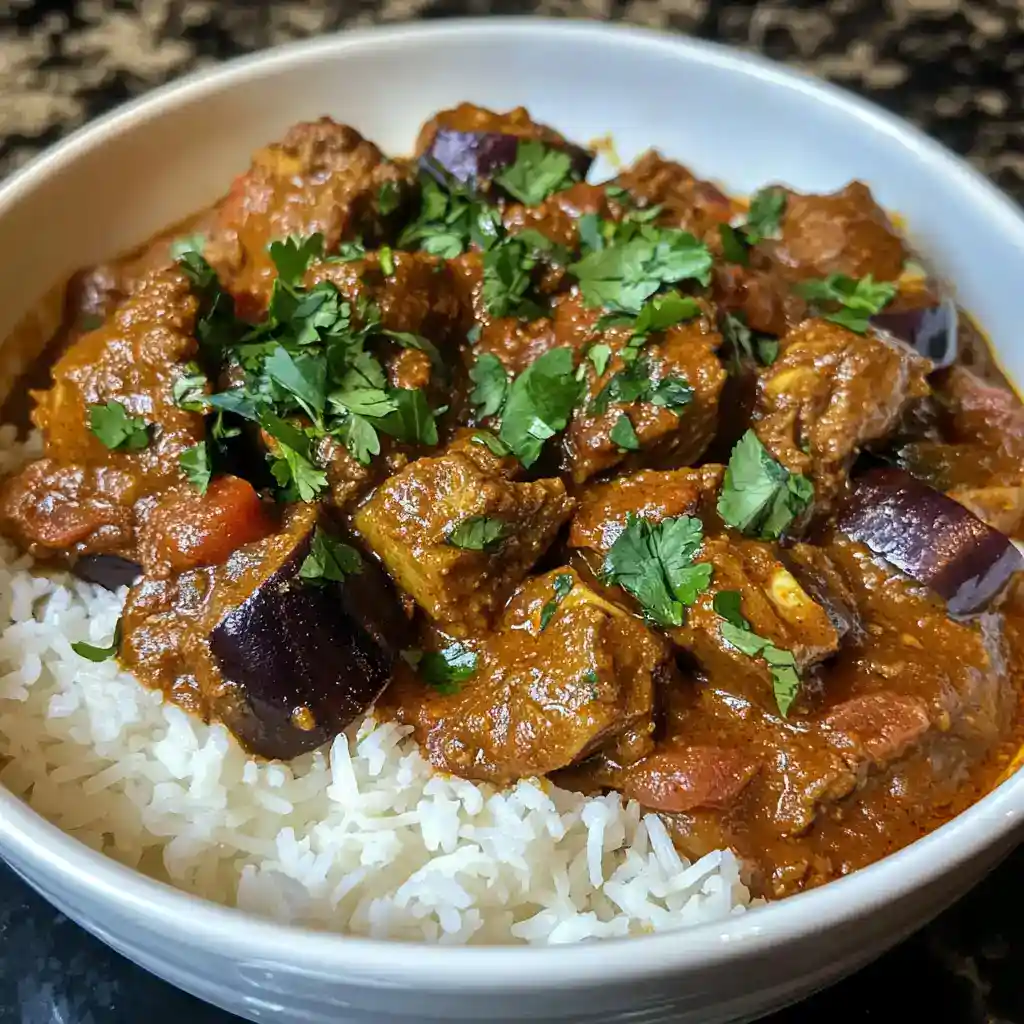
Taste and adjust seasoning. Serve over cooked rice with fresh cilantro scattered generously over the top.
For another deeply satisfying lamb curry with a different spice profile, check out this Lamb Rogan Josh from Station Recipes — a paprika-spiced North Indian variation that’s equally rich and aromatic.
If This Happens, Don’t Panic
Lamb is tough after 1 hour? The cut was too lean or the heat was too high. Drop to the absolute lowest heat setting and give it another 30 minutes. True tenderness happens when the lamb pulls apart with a fork with almost no resistance.
Curry is too thin? The eggplant hasn’t broken down enough yet, or too much coconut milk was used. Simmer uncovered for 10 additional minutes to reduce and concentrate. The eggplant should be completely soft and partially dissolved into the sauce.
Eggplant tastes bitter? The eggplant was old or had begun to oxidize. Fresh eggplant is essential for the sweet, creamy result. A small pinch of sugar can help balance residual bitterness, but prevention is better — use fresh, firm eggplant.
Curry tastes flat? The spices weren’t bloomed long enough, or the curry powder is stale. Add a squeeze of lemon juice — it brightens everything immediately. A small pinch of garam masala stirred in at the end also adds fragrant warmth.
Ways to Mix It Up
Lamb and Eggplant Vindaloo: Add 1/2 teaspoon of cayenne pepper and 2 tablespoons of vinegar with the coconut milk for a spicier, tangier variation inspired by Goan vindaloo.
Spinach Lamb Curry: Stir in 2 cups of fresh baby spinach in the last 5 minutes of cooking. The spinach wilts almost instantly and adds color, nutrition, and a mild earthy note that pairs beautifully with lamb.
Chickpea Lamb and Eggplant Curry: Add one drained 15 oz can of chickpeas in the last 20 minutes of cooking. The chickpeas absorb the curry sauce and add protein and texture, making this even more substantial.
Thai-Style Lamb Curry: Replace the curry powder with 2 tablespoons of red curry paste and add a stalk of bruised lemongrass and 2 kaffir lime leaves with the coconut milk. Remove the lemongrass and lime leaves before serving.
What Makes This Recipe Special
Eggplant curry appears across multiple South Asian and Middle Eastern culinary traditions — from Indian baingan bharta to Turkish patlican musakka — because eggplant’s spongy texture makes it uniquely suited to absorbing and carrying complex spice flavors. The combination of lamb and eggplant is particularly characteristic of Afghan and Pakistani cooking, where the vegetables’ silky texture provides contrast to the robust meat. Learn more about the global history of lamb and mutton cooking and why this protein has been central to curry traditions for centuries. This lamb and eggplant curry honors that tradition with a technique that’s accessible to any home cook.
Questions I Always Get
Can I use beef instead of lamb for this curry?
Yes — beef chuck works with the same technique and timing. The flavor is slightly different — less gamey, more robust — but equally good. Everything else stays the same.
Do I need to salt and drain the eggplant first?
No — that’s for frying or grilling to prevent bitterness and excess oil absorption. For braising in curry, the eggplant goes in raw and breaks down naturally during the simmer, contributing to the sauce’s texture and body.
Can I make lamb and eggplant curry in a slow cooker?
Yes — brown the lamb and bloom the spices on the stovetop first, then transfer everything to the slow cooker and cook on low for 6 to 8 hours. The lamb becomes very tender and the eggplant completely dissolves into the sauce.
Is this lamb and eggplant curry recipe beginner-friendly?
The technique is approachable — brown, bloom spices, add ingredients, simmer. The most important skills are browning the lamb properly and blooming the spices for the full time. If you can do those two things and maintain a gentle simmer, you’ll make excellent curry.
How do I store and reheat lamb and eggplant curry?
Refrigerate in an airtight container for up to 4 days. The curry actually improves overnight as the flavors continue to meld. Reheat gently on the stovetop over low heat with a splash of coconut milk or water if it thickened too much.
Can I freeze lamb and eggplant curry?
Yes — it freezes beautifully for up to 3 months. Cool completely before freezing in portions. Thaw overnight in the fridge and reheat gently with a splash of liquid. The eggplant texture may soften further but the flavor is excellent.
One Last Thing
Lamb and eggplant curry is the recipe I make when I want something that feels like genuine cooking — where the technique and the time investment produce results that are noticeably better than shortcuts could achieve. The fragrance while it simmers, the way the eggplant melts into the sauce, the tender lamb that pulls apart with a fork — it’s deeply satisfying in a way that makes the hour of simmering feel worth every minute. Make it on a Sunday and eat well all week. You’ve got this.
Print
Lamb and Eggplant Curry
Description
Rich, aromatic lamb and eggplant curry with tender lamb shoulder, silky eggplant, and coconut milk in a warming spice blend — a deeply satisfying curry ready in about 90 minutes.
Prep Time: 15 minutes | Cook Time: 1 hour 15 minutes | Total Time: 1 hour 30 minutes | Servings: 4
Ingredients
- 1 lb lamb stew meat (shoulder), cubed
- 1 large eggplant, diced into 1-inch pieces
- 1 onion, chopped
- 3 cloves garlic, minced
- 1-inch piece fresh ginger, grated
- 2 tomatoes, chopped
- 1 can (14 oz) full-fat coconut milk
- 2 tbsp curry powder (fresh)
- 1 tsp turmeric
- Salt and pepper, to taste
- Oil, for browning
- Fresh cilantro, chopped, for garnish
- Cooked rice, for serving
Instructions
- Heat oil in a large pot over medium-high heat. Pat lamb dry and brown in batches without crowding, 2 to 3 minutes per side. Remove and set aside.
- Reduce heat to medium. Add onion and cook 5 minutes until soft, scraping up browned bits. Add garlic and ginger and cook 1 minute.
- Add curry powder and turmeric. Stir constantly for 1 to 2 minutes until the spices are fragrant and slightly darkened.
- Add chopped tomatoes and diced eggplant. Cook for 2 to 3 minutes until tomatoes begin to break down.
- Return lamb to pot. Pour in coconut milk and season with salt and pepper.
- Bring to a simmer, then reduce heat to low. Cover and simmer gently for 1 hour, stirring occasionally, until lamb is fork-tender and eggplant has softened into the sauce.
- Taste and adjust seasoning. Serve over rice, garnished generously with fresh cilantro.
Nutrition Information (Per Serving, without rice)
- Calories: 450
- Carbohydrates: 18g
- Protein: 28g
- Fat: 30g
- Fiber: 6g
- Sodium: 420mg
- Iron: 4.2mg (23% DV)
- Vitamin C: 16mg (18% DV)
Note: Nutrition estimates are based on 4 servings without rice. Values will vary based on the lamb cut and coconut milk brand used.
Notes
- Pat lamb dry before browning — surface moisture creates steam instead of sear.
- Bloom the spices for the full 1 to 2 minutes in hot oil — this is the key step for deep curry flavor.
- Don’t salt and drain the eggplant — it breaks down naturally during the braise and thickens the sauce.
- Keep the simmer gentle — small, occasional bubbles, not a rolling boil.
Storage Tips
- Refrigerator: Store in an airtight container for up to 4 days. Flavor improves significantly overnight.
- Reheating: Warm gently on the stovetop over low heat with a splash of coconut milk if needed.
- Freezer: Freeze in portions for up to 3 months. Thaw overnight before reheating.
- Store separately from rice for best reheating results.
Serving Suggestions
- Over steamed basmati rice with extra cilantro
- With warm naan or roti for scooping
- With a side of plain yogurt or cucumber raita to cool the spices
- Topped with a squeeze of lemon for brightness
Mix It Up (Recipe Variations)
Vindaloo: Add cayenne and vinegar for a spicier, tangier Goan-inspired variation.
Spinach: Stir in fresh baby spinach in the last 5 minutes for color and nutrition.
Chickpea: Add a drained can of chickpeas in the last 20 minutes for extra protein.
Thai-Style: Replace curry powder with red curry paste; add lemongrass and kaffir lime leaves.
What Makes This Recipe Special
Eggplant’s cellular structure makes it uniquely suited to long braises like this lamb and eggplant curry. The vegetable is composed of spongy parenchyma cells with large air pockets that rapidly absorb liquid during cooking. As the eggplant simmers in the coconut milk and spiced liquid, these cells collapse and release their moisture while simultaneously absorbing the surrounding curry sauce. After about 45 minutes of gentle simmering, the eggplant has essentially become part of the sauce rather than a distinct ingredient — it contributes body, a subtle sweetness, and a velvety texture that thickens the curry naturally without any added starch or cream. This is why eggplant curry has such a different mouthfeel from other vegetable curries — the eggplant transforms the sauce itself rather than simply sitting in it.
